Saturday, February 4, 2012

Celebrating Chinese New Year the Malaysian Way

          Ask me what I personally like best about the Lunar New Year (or what more commonly known as the Chinese New Year) and I shall tell you that I enjoy the Reunion Dinner on the eve of Chinese New Year the best. The reason? Well, it seems to be the only time of the year when members of the family are gathered over the dining table with a wide variety of delectable cuisines served. 


          Arrica and the family

          What mattered the most, somehow, was not the food (although food was indeed what brought everyone together), but instead the bonds between family members that only grew stronger over the dinner filled with conversations and lots of laughter. And that makes the Reunion Dinner especially remarkable in welcoming the arrival of a brand new year. 


          Aaron and the family

Sherilyn and the family
          
         Besides that, the Chinese New Year also seemed to be the only time of the year when members of the family actually get to reunite and enjoy more of each others' company, thus I believe that it should also be known as a celebration of togetherness, where gatherings and house-visits among relatives, friends or even colleagues would be ubiquitous. Collection of ang pows or red packets (filled with money... and blessings) is also an all-time favorite. ;) 


 Ang Pow Packets

Eden and friends

Aaron and... lots of girlfriends?

          Chinese New Year cookies (it's about food yet again) were also hunted weeks in advance before the arrival of the festivity as they are the essential goods that you simply cannot do without during house-visits, either to serve your guests with the cookies or to exchange them as gifts. Something worth noting is such that one could become protective over their own favorite cookies deemed as nothing but the best, while yours truly too has her personal favorite when it comes to something as important as pineapple tarts. :) 


Error 101: No picture found. Pineapple tarts went missing in action.


        Last but not least no festivity would be festivity when there are no fireworks. Despite being contraband items, fireworks still ignite brilliantly in the skies all around your neighborhood, smelling like charred barbecue meat. It is somehow undeniable that fireworks add sparks to the festivity and noises are just something that we would not want to do without. So, watching the fireworks would also be a must when it comes to the celebration of Chinese New Year. 


Happy Chinese New Year! 


Sincerely,


The Bragging Brats 

History of Chinese New Year

The Chinese New Year has a great history. It has been practiced by all Chinese around the world. Even the other races and religions are celebrating it nowadays and practices the culture as well. Now do you know how it is all started ?

It is all started out because of fear. It is all based on a story which is centuries old ago and it passed down from a teller to teller. It was about a terrible mythical monster who look like a giant lion and it was named Nian (年) which is also the meaning of YEAR. It preyed on villagers and everyone are in feared everyday.


One day, an old wise man came out with a plan by making loud noises with drums and firecrackers and hanging red paper cutouts, scrolls on their doors for reasons. Why red paper ? because the Nian is scared of the color red. The villagers then took the old man's advice. On a cold moonless night, the Nian came and hunt them again. However, all of the villagers were so cooperative and they follow the old man's advice. The noise of drums and gongs as well as the lighting bamboo frighten the Nian. At that moment when the Nian is weaken, they jumped up and killed the monster together.


That day onward, it became an anniversary of the date. The Chinese recognize the "passing of the Nian" known in Chinese as "Guo Nian" (过年), which is also synonymous with celebrating the new year.

Some people may ask, why Chinese New Year celebrate different dates every year. The date of Chinese New Year changes every year because it is based on the Lunar Calendar, while the western based on Gregorian calendar which is calculate the earth's orbit around the sun. Easier way to find out when is Chinese New Year, is to observe the moon after winter solstice. It is falls on the next new moon after Winter Solstice.

Below is the picture that how recent days Chinese celebrate CNY. They all came together and share the joy and happiness.

Why is Chinese New Year celebrated?

  Chinese New Year celebrates changes; getting rid of the old and welcoming the new. It is essential for all of us to understand the rationale behind celebrating Chinese New Year.

  In the far east, the celebration marks the end of winter and the beginning of spring. Many farmers grabs this golden opportunity to usher in the spring season as they plant for the new yield. Hence, Chinese New Year is also known as Spring New Year.

  We also celebrate Chinese New Year as it is the time of the year when presumably, every member of the family gathers for reunion dinner on New Year's Eve. No matter where one and another lives, the celebration of Chinese New Year brings us back together to share the joy of welcoming the new year.

 Photo source: ilearn-culture.com

  Some Chinese does not eat meat on the first day of Chinese New Year because they believed that each new year carries the name of an animal, as seen in the Chinese Zodiac. Rice is considered as the must-eat food for New Year's Eve dinner as it safeguards and ensures harmony in the family.

  As mentioned before, Chinese New Year is celebrated to scrap the old and greet the new. It is the time to revamp oneself and get rid of grudges, especially among family members. It is regard as true that one should not carry resentments and bitterness into the New Year.

  Along with the Chinese New Year celebrations, there are multiple traditions and beliefs that the Chinese needs to follow closely to ensure a prosperous New Year, like not sweeping the floor on the first day of celebration as it is believed that doing so will 'sweep' away bad luck, decorate the house with red color and placing mandarin oranges in bowls throughout the house as they are the fruits of happiness, and avoid wearing black because the color symbolizes bad luck and death.


Friday, February 3, 2012

Little India Brickfields at Jalan Tun Sambanthan

If you were to talk about where will you get more choices on traditional Indian goods such as saris and spices, to local delicacies like thosai, vadai and more. First thing come into mind is this very place that we are going to brag about, the Little India Brickfields.


Now let us start bragging with the history of Little India Brickfields. The original Little India used to be located along Jalan Tunku Abdul Rahman and then when it comes to 2009, Malaysian Prime Minister, Datuk Seri Najib Tun Razak annouced that the Little India would be moved to Brickfields as the Malaysia's official Little India. As for your information, Brickfields is also known as one of the oldest Indian settlements in the country.


Apart from Indian food and culture you can also find Buddhist temples, mosque and churches in Brickfields, which attracts most of the tourist visitation. It is recommended for you to visit during the weeks leading up to Deepavali in mid October, as because it will turns out a whole new colourful look on the street itself.


Along Jalan Tun Sambanthan, we can find Vivekananda Ashram which constructed in 1904. This elegant building with Moghul style embellishments was named after an Indian spiritual leader Vivekananda who visited Malaya in 1893. Currently is being used for spiritual education classes, prayer meetings and so on. That is his statue standing infront of the building.


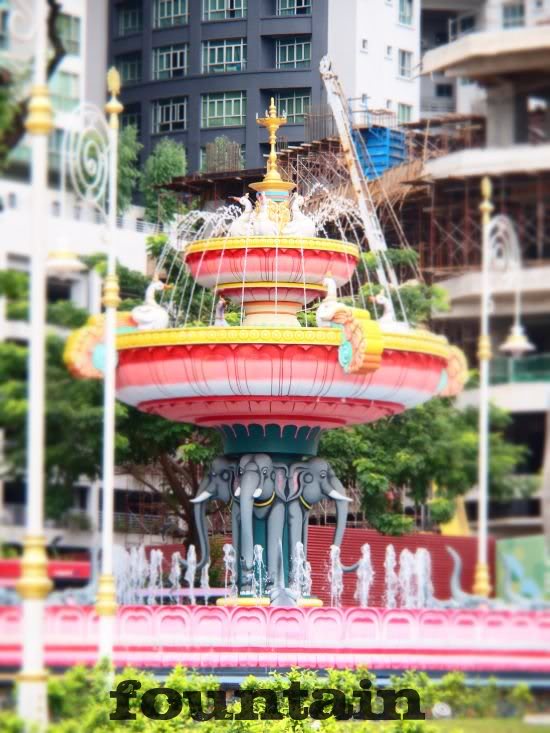
Next, the 11m wide three-tiered fountain with the elephant and swan sculptures and lotus motifs carry their own meaning in it. The swans are revered in Indian culture as manifestations of saints who are in the physical world without getting attached to it; just as a swan’s feather does not get wet even when in water. While the elephant represent strength, intelligence, loyalty, spiritualism and obedience to the elders. It is a one meaningful fountain to them.


The colourful shop lots along Jalan Tun Sambanthan.


Brickfields is often called a Divine Location as because it seems to have more than one places of worship from different faiths. This are one of the many places of worship from different religion, The Holy Rosary Catholic Church. It was completed in 1904 and got damaged during World War II. Therefore renovation took place on 1950s. It was constructed by Father Francis Emile Terrien, a French missionary. It has listed in one of the most beautiful churches in Malaysia.


Lastly, if you are interested in visiting Little India in Brickfields at Jalan Tun Sambanthan, there are rail lines run along the road, which is Tun Sambanthan Monorail or the nearby one KL Central Monorail.


Tuesday, January 31, 2012

Street Roving in KL - Jalan Tun Perak


In conjunction with the annual Federal Territory day, we went roving around the streets of Kuala Lumpur to uncover for ourselves the insights to this vibrant and dynamic city where typical urbanites like us live, eat, work, sleep, play and breathe in on a daily basis. 

As it turns out, there are actually so much more than just modern skyscrapers and well, ahem, severe traffic congestion to the Federal Territory of Kuala Lumpur, while we specially handpicked just a few of them to be bragged about. ;)

            Our journey began at no other than the heart of Kuala Lumpur itself that gives pulse to the city. As it is well-said that history are often written by winners or people in power,  little actually knew that there were a few other street names that took precedence over what prevalently known today as the famous Jalan Tun Perak.


Jalan Tun Perak which started as a busy commercial district in the past still remains one of the main arteries of the city today.


The bustling street that gathers people from all walks of life today was once known as Java Street for more than half a century until before World War II. It was only until after Independence Day that the street was renamed Jalan Mountbatten after Lord Louis Mountbatten - who was the Allied Supreme Commander in Southeast Asia during the period of warfare.


Jalan Mountbatten around the 1960s

One of the most symbolic attractions along Jalan Tun Perak would be no other than the very famous Masjid Jamek or the Jamek mosque. Strategically located at the convergence of Sungai Klang and Sungai Gombak, Masjid Jamek once served as the primary venue of congregation for the local Muslim community, until more than five decades later when the national mosque was built. 


Masjid Jamek or the Jamek Mosque also serve as an important landmark along Jalan Tun Perak today. 


Finally getting to witness the legendary Sungai Gombak flowing in real, we brats must say that it is, well, ahem, overrated for most of the time.


Well, we believe much more efforts should be done to preserve the rivers, especially when they are associated with national heritages and being widely promoted as tourist attractions. 

          Where there is a Big Ben in London, there is also a Sultan Abdul Samad building in Kuala Lumpur. Located just across the Klang river from Masjid Jamek, the 40m high clock tower crowned by a golden dome bears resemblance to the Big Ben in London. It was built by the British governance to house important government departments back then during the colonial era. 


The Moorish architecture of the Sultan Abdul Samad Building also resembles that of the Jamek Mosque. 
                     
Sultan Abdul Samad was the fourth ruling monarch of Selangor.

                  While the Sultan Abdul Samad building could have signified the British colonial era in Malaysia, ironic enough is such that located just opposite the building is Dataran Merdeka, or the Merdeka Square, where the Union Jack was lowered and where Malaysia was finally declared as an independent nation. Merdeka! 

Dataran Merdeka marked the termination to the British colonial era. 


The 95m flagpole in Merdeka Square, ehem, the tallest in the world. :)


Sincerely,

The Bragging Brats
Federal Territory Day


As morning draws , the clouds are shady , the sun is unseen , a perfect day to conduct outdoor activities . Brushing my teeth , getting dress and followed by taking my breakfast , it's time to head for my destination , Dataran Merdeka .

Even though the exact Fedaral Territory Day is on Feb 1 , the government decided to held the celebration on both saturday & sunday so that citizens with their families are able to not just take part but also to enjoy this experience . I too had never witness such celebration before , together with my group members Arrica & Zi Wen to snap pictures for our assignments .


Taking the usual routine , I arrived half and hour later and waited for the rest at Mc'D . According to source , Our Prime Minister Datuk Seri Najib Tun Razak and other representing bodies had up to 8000 members already . This include the government sector , bank , schools and so on . Hence we were expecting a huge crowd .
 At sight , flags are hanged all over , there are stations through out the entire areas , the whole road was fully occupied . Next are the marching squats , not just one or two but several.  Even though I know not much about what group they are representing , but one thing I know they practice a lot . The teamwork , the effort they put in , the timing of their steps , their strength in carrying heavy instruments , everything is shown in their performances .

Unfortunately we miss the parade which is shown much earlier , luckily for us there are still several events being carried out . Not to mention , there are fireworks at night which we are not able to stayed to witness . We then headed to the sector where most people are gathering . It seem that the there are dance competitions coming right up and there are BMX competition as well .

As teams are signing up , people are drawn towards teams that are warming up , getting used to the stage . The music were pumping real loud , it too play a role for drawing everyone attentions . Then there was the bike competition , where most I would say teenagers are hanging around with their bikes , taking turns to present their skills of the (          ) .

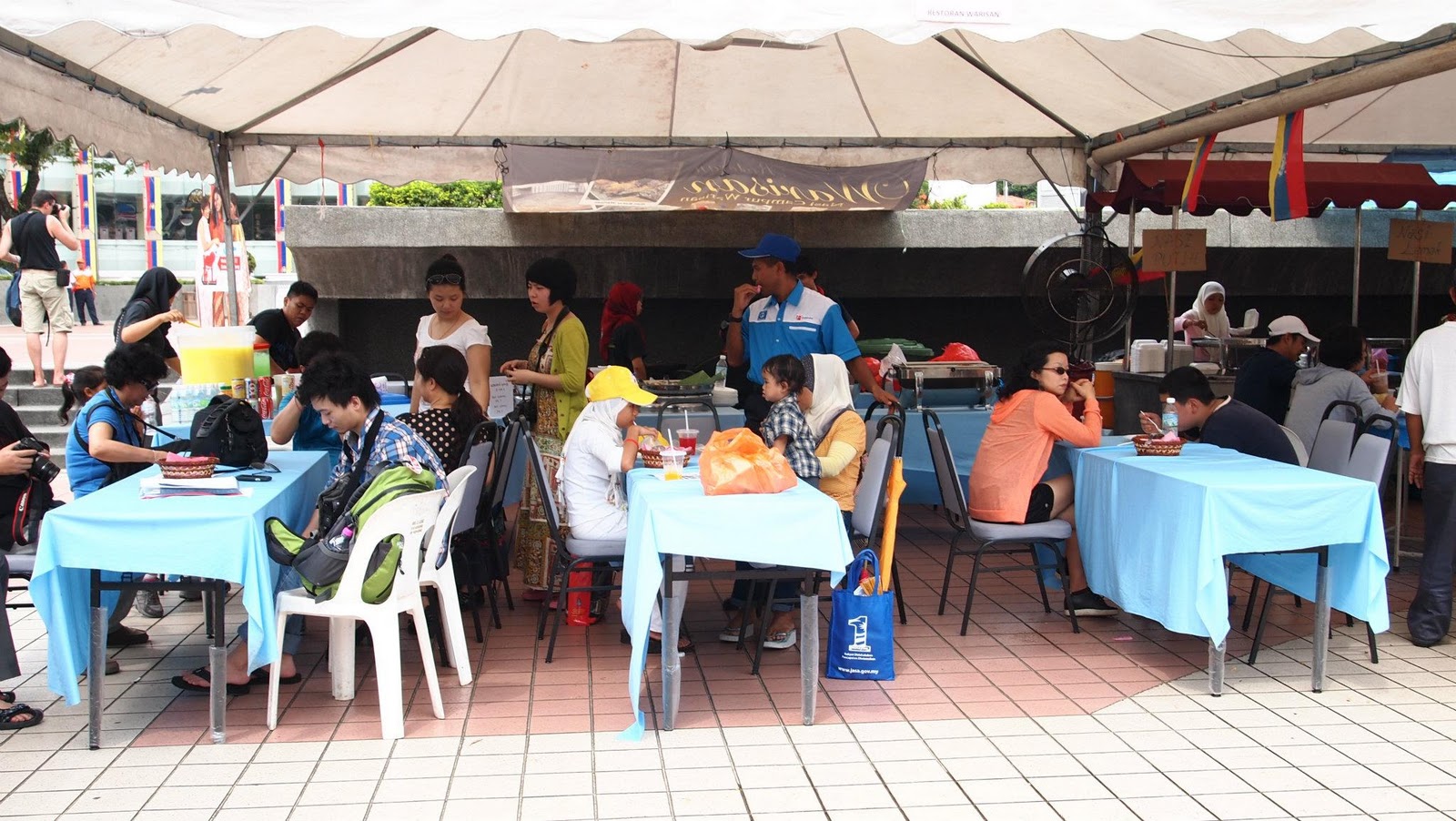
While waiting for competitions to start , the weather is getting scorcher , our hairs are as if on fire . Hence we went to stalls selling food nearby , to get some refreshments . A variety of foods were sold there , and ice creams were our choice after inspecting through all the stalls . 

It almost pass 1:00 pm yet neither competitions are starting even though they are suppose to start at 12 . As we thought there are nothing left to be seen , we found a section where arts , creativity , talents are the focus . A showcase of various art works like singing , drawings , handwork are all to be found here . A colourful and inspiring area indeed . 


We conclude our work for the day as we finishes this section . Information and pictures are taken , new knowledge had been learnt and experienced . All is left now is to organize and present everything in report to be handed over . And this too is part of it . Thank You .

Monday, January 30, 2012

Element of Communications

1,)  Source idea
      - formulate ideas , to communicate with others

2.)  Message 
      - what to communicate
      - craft to meet the needs of audience

3.) Channel
      - medium of communication
      - transmit msg from one to another , without changing the content
      - PATH of communication from sender to receiver

4.)  Receiver 
      - party receiving communication , from transmitter

5.)  Decoding 
      - message is interpret for its content
      - think & interlize
      - compare msg to priors experience / external stimuli

6.)  Feedback 
      - convey whether message is understood
      - format an appropriate reply base on msg